
PTAD-Azide
产品价格
| 产品编号 | 品牌 | 包装单位 | 单价(元) | 现货 |
| 3210710 | Sigma-Aldrich | 50 MG | 2120 | 请咨询 |
结构式
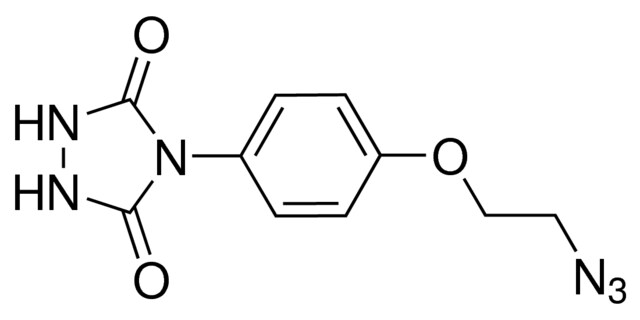 |
基本信息
| Empirical Formula【经验(实验)分子式】 | C10H10N6O3 |
| Molecular weight | 262.22 |
| MDL number | MFCD25976544 |
| PubChem Substance ID【PubChem化学物质编号】 | 329772652 |
| NACRES | NA.22 |
| General description【一般描述】 | PTAD-Azide (4-(4-(2-Azidoethoxy)phenyl)-1,2,4-triazolidine-3,5-dione) is a 1,2,4-triazolidine-3,5-dione derivative. It can be prepared from ethyl hydrazinecarboxylate. |
| Application【应用】 | PTAD-Azide is a selective crosslinking reagent that has one end for reacting with tyrosine and the other end for presenting an azide. After bioconjugation to tyrosine, the azide can be reacted with an alkyne through the Cu(I)-catalyzed click chemistry reaction or with a cyclooctyne in a copper-free reaction. This reagent has been shown to selectively introduce poly(ethylene glycol) or PEG chains onto proteins with surface exposed tyrosine residues. PTAD-Azide has also been used in the formation of antibody-drug conjugates. This reagent is compatible with different buffer systems such as PBS, Tris and mixed PBS/Tris buffer (preferred). The linkage with tyrosine has been shown to be stable to pH and temperature extremes as well as blood plasma. Note: PTAD-Azide must be first activated by stirring in a 1:0.98 molar ratio with 1,3-dibromo-5,5-dimethylhydantoin (product # 157902). Activation is evident upon solution color change from colorless to deep red and the activated reagent should be used immediately. General Procedure for Protein Modification with PTAD. Part 1: PTAD activation
Part 2: Protein modification
PTAD-Azide may be used in the preparation of 4-(4-(2-azidoethoxy)phenyl)-3H-1,2,4-triazole-3,5(4H)-dione and aplaviroc-urazole. This urazole was recently demonstrated in the traceless, chemoselective labeling of peptides and proteins through electrochemical tyrosine-click (e-Y-CLICK) chemistry. |
| Other Notes【其他说明】 | Electrochemically Promoted Tyrosine-Click-Chemistry for Protein Labeling |
产品性质
| Assay【测定】 | 95% |
| form【形式】 | powder or crystals |
| reaction suitability | reagent type: cross-linking reagent |
| storage temp.【储存温度】 | 2-8℃ |
| SMILES string | O=C(NNC1=O)N1C2=CC=C(OCCN=[N+]=[N-])C=C2 |
| InChI | 1S/C10H10N6O3/c11-15-12-5-6-19-8-3-1-7(2-4-8)16-9(17)13-14-10(16)18/h1-4H,5-6H2,(H,13,17)(H,14,18) |
| InChI key | MHGMHPVYCVQIET-UHFFFAOYSA-N |
| packaging【包装】 | 50 mg in glass bottle |
安全信息
| Storage Class Code【储存分类代码】 | 13 - Non Combustible Solids |
| WGK | WGK 1 |